Thursday, September 22, 2016

Screenshot references for ResuPress/Storys.JP/Ekino/UNITE, etc., CIA et al. front companies and frontmen

Considering the fact that there is too much information to cover in a concise manner due to the more pressing matter at hand of filing the Appeal with the D.C. Circuit Court, I'm going to post this series of screenshots of archived webpages of the above-named company (ResuPress) and its purported services along the course of its progress since being launched in August, 2012.

The flagrant misreepresentations (outright lies, perhaps), inconsistencies, etc., by Riney, Mizobe, and Otsuka are to be examined with reference to the screenshots in this post, as opposed to uploading them redundantly across multiple posts.

The pages have been grouped together in "phases" corresponding to their release in respective series.

As a sort of spoiler, I'll just state in advance that the evidence below shows that the so-called "video resume" startup described by Riney in his interviews (i.e., http://www.disruptingjapan.com/why-japanese-vcs-are-losing-out-james-riney-of-500-startups/) was in fact planned to itself provide service as a venture fund to support new startups both financially and materially, going so far as to offer legal services...


Phase 1
First ResuPress “Home” webpage, archived October 27,2012:

This page includes a sentence describing the upcoming service Storys.jp, 
“Storys.jpは、あなたの経験、プロジェクト、そして共に働いた仲間などの”名刺にのらない”ストーリーを共有する新しい空間です。”


First ResuPress “Overview” webpage, archived October 27,2012:
This page includes the following information indicating that the company is going to develop web applications that will revolutionize the world, with three people listed as “Board members”, including Riney, Koichiro Wada, and Keisuke Wada (the VC from “Incubator”):
ライニー ジェイムズ (James Riney)
和田 晃一良 (Koichiro Wada)
和田 圭祐 (Keisuke Wada)
世界に革命を引き起こすWebアプリケーションの開発


First ResuPress Announcements page, archived November 3, 2012:
This page includes the following information indicating that the company was founded on August 28, 2012, and that Incubate Fund and ANRI are investors:
2012.10.05 Incubate FundANRIを割当先とする第三者割当増資を実施
2012.08.28 レジュプレス株式会社 設立


First ResuPress Index page, archived November 4, 2012:
http://web.archive.org/web/20121104235521/http://www.resupress.com/index.html


Phase 2
The following two pages, archived on December 22, 2012, are the same, with a single slide reading “Venturing Japan?”


Phase 3
Next, they added  slides for two new/upcoming services in March, 2013, the homepage displaying a total of three services: Venturing Japan support for launching a business in Japan; STORYS.JP; and Ekino, which states “An Online Flee Market at Every Train Station”. Meanwhile, they eliminated the detailed text related to localization and strategic partnerships: http://web.archive.org/web/20130304141900/http://www.resupress.com/


Two of those slides lead to archived pages, but the “Venturing Japan” link was blocked from archiving by implementing robots.txt: http://web.archive.org/web/20130304141900/http://www.resupress.com/services.html

There is a currently active version of that page, but it is password protected:

Phase 4
The fourth version of the ResuPress homepage, archived in April of 2013, eliminated the Venturing Japan and Ekino services, and included the following statements:
ResuPress is a Tokyo based tech startup focused on building exciting new ventures and bringing them to the world.
ResuPress was founded by James Riney, Koichiro Wada, and Takuro Mizobe with the support of Incubate Fund and Anri Fund.
The Board was comprised of:
“James Riney, Koichiro Wada, Keisuke Wada”
And the Team was comprised of:
“James Riney, Koichiro Wada, Takuro Mizobe, Keisuke Wada, Anri Samata, Nicholas Gianniotis (Advisor)”
Note that Otsuka has yet to appear on either list.


Phase 5
There are no changes until June 25, 2014, when a link/graphic for a new service called Unite is added, the names of Riney and Gianniotis are deleted from the page, with Otsuka’s name appearing for the first time on both the Team list and the Board list, to which Mizobe has also been added.


Phase 6
The next change happens in August, 2014, with the Unite service being deleted, and the Coincheck service added:


STORYS.JP

The first homepage of STORYS.JP, archived on March 1, 2013, does show Otsuka on the Team, and includes a third investor, Teddy Lo, who also happens to operate a Crossfit business in Hong Kong. The page also includes links to personal stories the team members and investors have uploaded onto the website:


The page remains basically the same through October 10, 2014, with Riney still shown as a member of both the Board and Team, even though he had already left the company, and then the “About” page showing information about the company itself was eliminated from the website altogether:

The next archived page shows that it had been deleted by the company:


Tuesday, September 20, 2016

BITCOIN: provisional note 2

A hypothetical situation has come to mind so I’m going to pose a couple of question based on that.

First, with respect to the launch of Bitcoin technology, why would an individual associate his name with the published code and not take credit for the technology? Second, in the same vein, why would someone that produced such an invention—patentable by any standard—assign a pseudonym as the name of the person releasing the discovery to the world? Third, why would the name be a Japanese name? Considering that the NSA has the world’s foremost capacity in cryptology and limitless computing power, it would not only be a natural byproduct of the activities of the NSA to produce something along these lines--even in simply investigating the potentialities for such a technology that anyone could develop eventually--especially if they were requested to by another agency, such as the CIA. It would also be a technology that they could readily exploit to cyber mint their crypto currency in large amounts should it achieve acceptance. That could also serve as a possible source of funding for covert operations that wouldn’t even have to be disclosed to the U.S. Congress, so long as the existence of such a program was not acknowledged. Hey, it would beat smuggling and peddling cocaine to arm the Contras, right? Are you too young to know about the Iran-Contra Affair?

Considering that Japan seems to have overtaken the US in terms of the transactional volume of Bitcoins (http://cryptohustle.com/bitcoin-trading-volume-japan-on-the-rise), there are a number of questions that arise related to the use of Bitcoin in Japan.

The next individual to be examined on his blog is Yusuke Otuka (大塚雄介), the CMO of Coincheck who misrepresents himself as having co-founded its mother company, ResuPress. In this interview in Japanese (https://www.green-japan.com/company/4484), Otsuka claims that the transactional volume at Coincheck was more than 16 billion yen/month as of February 2016, approximately 18 months after the service was launched in August 2014:

coincheck20148月にサービスを開始してから約1年半で、月間取引高160億円を超える日本最大級のビットコイン取引所に成長。

Coincheck was launched in August, 2014, and the monthly volume of Bitcoin transactions after about a-year-and-a-half exceeds 16 billion yen, making us the largest Bitcoin exchange in Japan.

Otsuka also suggests that many of their users are young men in their 20s-30s with internet literacy.

現状、日本ではビットコインに興味を持つ、または実際に取引しているユーザーは20代~30代の男性が多く、インターネットの知識やリテラシーを持つ人が多い。そのため、実店舗でビットコイン決済ができるサービスは、そのような男性が集まる店舗での導入が多い。

At present, many of the people in Japan that are interested in Bitcoin and/or actually conducting transactions in Bitcoin are young men in their 20s-30s that have internet literacy. Accordingly, many of the businesses that have introduced systems enabling them to accept Bitcoin are businesses that cater to such young men.


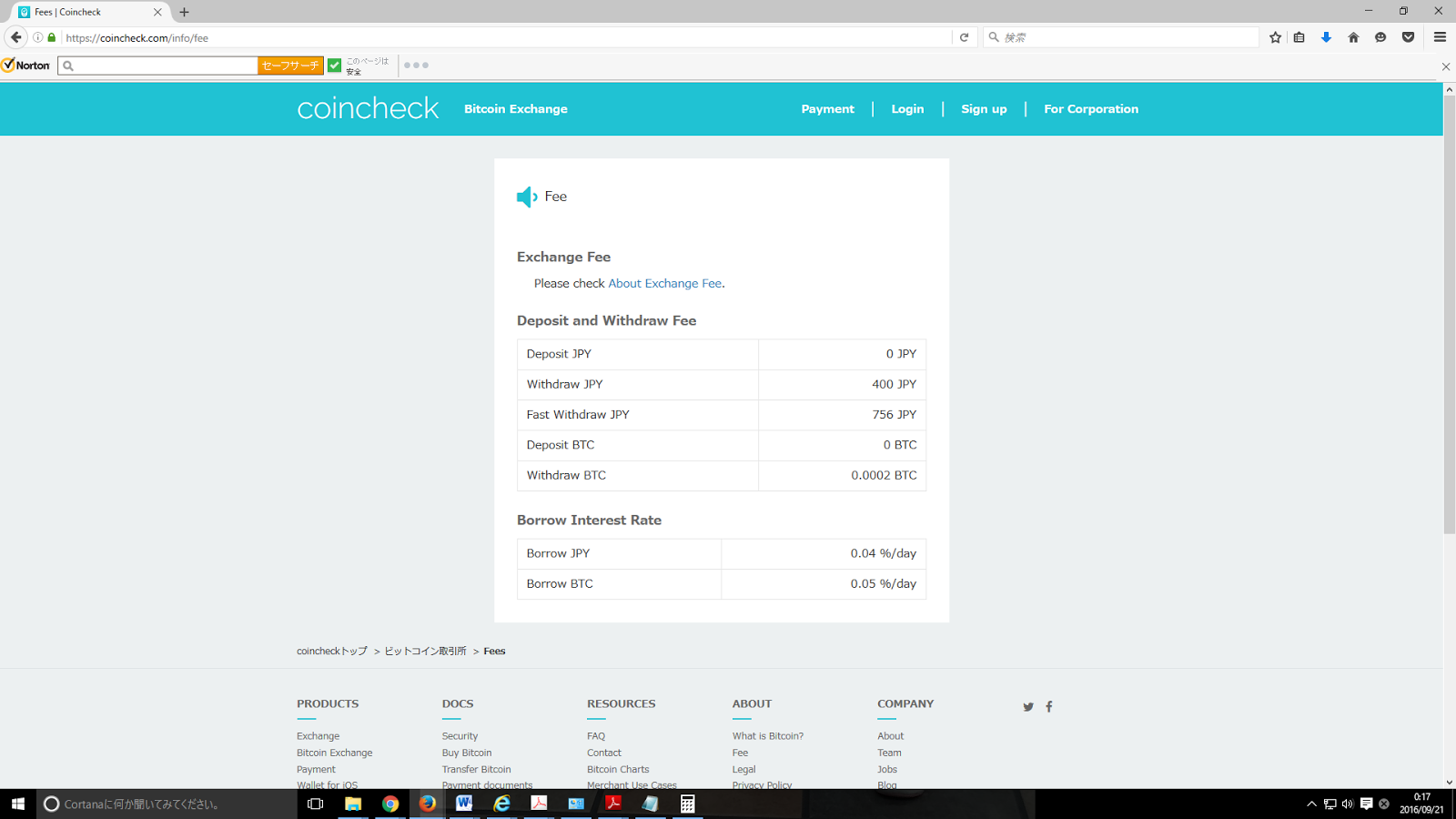
Let’s put that into perspective. Accordingly to Otsuka, Coincheck services about $160 million in Bitcoin transactions per month, on the one hand, and claims that many of its customers are IT savvy young men in their 20s-30s. While it is reasonable to assume that institutional investors must be active in trading Bitcoin Japan (would they be using Coincheck?), it is hard to imagine what types of transactions could be being conducted to account for such a high volume, especially if the customers are mainly young men in their 20s-30s. $160 million dollars is not a trivial amount of money. I will cover Coincheck in a separate post, but this is a screenshot (https://coincheck.com/info/fee) of their fee schedule in English:


In the above-linked article from online publication “Crypto Hustle”, Alan Struna (who?) states the following:

The high trading volume in Japan likely increased market demand for bitcoin. []
Japan is looking to create a stimulus package for the banks with $100 Billion of helicopter money to bring interest rates back to 0%. In other words, banks will literally print money out of thin air as a last resort to stabilize the economy.
What does this mean for Bitcoin? As we’ve seen in China, when local currencies fall people look to hedge against the economy and banks. While the news hasn’t been officially released yet, Japanese investors may look to bitcoin as a hedge against the inflation of the Yen.

Struna echoes the same Wall St. party line with respect to “helicopter money” as suspected CIA officer William Pesek, who writes for Bloomberg and the Japan Times. While it’s true that the stimulus packages primarily benefit large corporations and the stock market, it is not true that the use of such stimulus packages necessarily equates with a devaluation of the yen, or that a devalued yen wouldn’t negatively impact the value of Bitcoin, rendering the suggestion that it be used as a hedge ridiculous. The yen is so strong because international investors see Japan as a “safe haven” from global market turmoil.

While Struna focuses on the Japan Times articles mentioning the function similar to money, the more important quote is the following:


The latest bills on virtual currencies recognize them as asset-like values that can be used in making payments and be transferred digitally.

Here, it bears mentioning that Bitcoin is taxed with a capital gains-like tax in some places, and in other ways as well (https://bitcoinmagazine.com/articles/tax-day-is-coming-a-primer-on-bitcoin-and-taxes-1459786613). There have been calls to make Bitcoin “tax-free” in Japan, but there would not seem to be a rational basis for doing so, as that would only make Japan a sort of Bitcoin tax haven. This an old article on the scenario in Japan: http://financegreenwatch.org/?p=11993. The government has yet to address the question, but it is clear that Bitcoin poses a number of finance sector funny-money chicanery issues. The most recent news is this: https://bitcoinmagazine.com/articles/japan-debates-bitcoin-sales-tax-stricter-rules-for-exchanges-1457633456. That set of proposals seems to have been stalled due to complaints from Japanese "digital assets" investors regarding the EU Court declaring Bitcoin to be a currency instead of a commodity, which is what the US had defined Bitcoin as a month earlier. Clearly, there is no international accord yet, and the EU ruling seems a little strange, to say the least. Apparently, the EU Commission has now taken notice (http://www.newsbtc.com/2016/07/06/european-commission-targets-bitcoin-tax-evasion-clampdown/), and legislative measures may be introduced overriding the Court’s ruling or implementing a regulatory regime similar to this: http://www.newsbtc.com/2016/05/29/bitlicense-did-good-by-bitcoin-sector/.

While I’m far from up to speed with the minutiae of cryptocurrencies, the big-picture issues are fairly clear with respect to the use thereof to avoid taxation and perform large scale illicit transactions that are essentially untraceable.


This blog intends to shed light on the involvement of intelligence agencies in the propagation of cryptocurrencies, since it has come to my attention that the CIA appears to be involved, and perhaps the Japanese Public Security Intelligence Agency  (公安省:  (https://en.wikipedia.org/wiki/Public_Security_Intelligence_Agency). On the other hand, that agency seems more akin to the FBI, not the CIA, which the Japanese government has been rumored to be establishing a version of, but maybe that is a fact that could itself be considered classified with the passage of the State Secrets Act . 

Monday, September 19, 2016

Who is Takuro Mizobe (溝部拓郎)?

The first suspicious thing one notices appears in the information on his LinkedIn profile—same as with Riney—where he states that he worked at STORYS.JP as an engineer for “2012 – 2012 (less than a year)”, but that is plainly a lie, as demonstrated below. 

When people are lying in concert, as it appears that Riney and Mizobe have been doing (don't worry Otsuka, you're next), they are doing so for a reason. I won't be able to speculate as to their motivations any further presently due to time constraints, but will get around to that after I've presented all of the relevant information about the group of individuals involved.

Accordingly, before getting started, I’m presenting the work history Mizobe posts on his LinkedIn profile, along with a couple of screenshots of Google search results regarding the employer he appears to currently claim.


Mizobe’s ‘work experience’ per LinkedIn (https://www.linkedin.com/in/takuro-mizobe-41402550):


Financial Institution     [AmeriCU Credit Union]

2012 – 2012 (less than a year)

2010 – 2012 (2 years)
I'm application developer as part-time job.


Mizobe is listed on the ResuPress website starting in December of 2012, and shown as a member of the staff on the STORYS.JP site through October 2014 (http://web.archive.org/web/20141010173529/http://info.storys.jp/about.html). Incidentally, Storys.JP was “officially” launched on February 27, 2013: http://web.archive.org/web/20130531044318/http://www.jamesriney.com/2013/02/.
The second suspicious thing is that he is quoted as a member of Coincheck in the finance publication article from September 2014 about BitCoin (http://www.coindesk.com/japanese-bitcoin-growth-continues-new-e-commerce-platform/), I linked to in that blogpost. Coincheck (https://coincheck.com/en/exchange) is one of the (two) “services” (https://en.wikipedia.org/wiki/Coincheck) of ResuPress (http://www.resupress.com/), but Mizobe is not listed as a member of the “team” (https://coincheck.com/en/contents/team-member). Maybe Mizobe doesn’t rate at this point as an “engineer” even though he represents the company when speaking to the press; however, he doesn’t list ResuPress or Coincheck on his resume at all, and it is clear from the aforementioned article that he worked for both at least through September 2014. Meanwhile, the other of the (two) “services” provided by ResuPress is STORYS.JP.

Finally, Mizobe never mentions JP Morgan on his work history, whereas Riney repeatedly makes reference to their fated meeting there… Mizobe does make a reference to working at a foreign investment bank in one of the personal “stories” he has posted to the STORYS.JP website (http://web.archive.org/web/20140403121912/http://storys.jp/takuro), but that is not worth presenting at the moment due to time constraints, as it appears to be merely another example of dissimulation.

Meanwhile, Otsuka—the current CMO—of Coincheck lists Mizobe as a member of the TEAM (Managing Director) on this webpage in the text at the bottom and in slide number 7 (of (8), which I’ve posted a screenshot of:


That slide is actually hosted on the following website, which can itself be archived, but only the first slide can be seen (http://web.archive.org/web/20160919161852/http://www.slideshare.net/yusukeotsuka750/coincheck-for-ec20141024?ref=http://sssslide.com/www.slideshare.net/yusukeotsuka750/coincheck-for-ec20141024), so I’ve manually archived the material, even though this screenshot is the only one of importance to this blogpost:


Otsuka also contradicts Mizobe by stating that Mizobe had years of experience at ResuPress/STORYS.JP as well. Moreover, Mizobe not only continues to be shown as a member of the TEAM on the ResuPress website—along with Riney—through May of 2014 (http://web.archive.org/web/20140513062113/http://www.resupress.com/),


but the purported “co-founder” is newly added to the list of Board members for the first time in July of 2014, the same time that Riney and his “advisor” (Nicholas Gianniotis) disappear from the list  (http://web.archive.org/web/20140625120029/http://www.resupress.com/),


It bears noting that the original Coincheck website was launched in Japanese (.jp) namespace, e.g.: http://web.archive.org/web/20141129211512/https://coincheck.jp/.  

The team list was removed by December 2014, and the names of the Board members, which still include Mizobe’s were converted to Japanese (http://web.archive.org/web/20141221205403/http://www.resupress.com/): 


Mizobe remains listed on that webpage, as shown below on the series of screens uploaded for the last archived version of that webpage (October 5, 2015: http://web.archive.org/web/20151005110243/http://www.resupress.com/), until the first archiving of the current iteration of the homepage dating to November 5, 2015 (http://web.archive.org/web/20151105042505/http://www.resupress.com/).
Top:


So, one question is, why has Mizobe emphatically misrepresented his relationship to ResuPress/STORYS.JP/Coincheck on his LinkedIn profile, apparently trying to conceal the fact that he is on the Board of Coincheck, on the one hand, while acting as a high-profile spokesman for the company in the English language press, as per the article I cited along with a quotation in the intial Bitcoin post on this blog (part of a series of articles found here: http://coinalert.eu/20160323110635-Coincheck+Brings+Ethereum+to+Japan.html). One factor may be that he wasn’t worried about the exposure in English, because he didn’t know that the Japan Times was going to delete the fairly innocuous comment I left on the Riney interview article, causing me to investigate the suspected CIA sociopath. 

A final question, moreover, is why is Coincheck, in fact, concealing the fact that Mizobe is a member of the Board and apparently the spokesman of the company with respect to the English press?


That question will have to wait for another day…

Sunday, September 18, 2016

Who is James Riney? .......................INTRO

There are a number of topics with respect to which I’ve only scratched the surface on this blog due to time constraints. In fact, I’ve elaborated more on some issues in the filings made with the D.C. District Court against the CIA et al., because that was—and remains—priority one. One such topic relates to the practice that has come to my attention of the defacto passing along of federal office in families of CIA officers. That is to say, the practice whereby the progeny of CIA officers themselves become CIA officers and continue to inhabit the same place as their parents did, etc., maybe even taking over the CIA-front family business. This is a feature of the neo-feudalistic tendency I’ve described to some extent, which is intimately connected to the correlative of neocolonialism. I will make a separate post on this topic, but I’ll note in passing that individuals with respect to whom, on the basis of my interaction with their fathers, there is no doubt in my mind are CIA officers that followed in their respective parent's steps include Ryan Taylor, the son of a former army buddy, Kris (aka Chris) Sawaguchi Roche (aka Sawaguchi (https://www.facebook.com/christopher.s.roche?fref=ts); aka Roche (https://www.facebook.com/krisrochemusic/?fref=ts)), Jonathan Levy (https://www.facebook.com/levyjon?fref=ts), Sage Einarsen (https://www.facebook.com/sage.einarsen), and Ron Beimel (https://www.facebook.com/ronald.beimel?fref=ts). I have submitted documentation/photos of the first four on that list to the D.C.District Court, and will post copies of those filing here eventually.

So, I present to you another father/son team of suspected CIA officers that have been intruded into my life through the Japan Times by the sociopathic Central Intelligence Agency of the United States of America.

While I don’t have time to dwell on the topic in a theoretical manner at present, suffice it to say that the father of James Riney (ライニー ジェイムズ), Tim (aka Timothy: ライニー ティモシー) Riney, is suspected to have been a CIA officer. In entries on the website his son co-founded,  Tim claims to have worked in six countries as an adult, and James writes that Tim met the love of his life--a German woman--in Portugal. I’ve been able to discover that Timothy Riney taught at the International Christian University in Japan—as per the following screenshots/excerpts until perhaps 5 years ago. On file is from the year 2000 (http://fd-newsletter.info.icu.ac.jp/backnumber/a-y-2000), and another seems to indicate that he was teaching through 2011 (平成23). This represents one more university in Japan that is populated with covert state actors in the form of CIA officers, etc. Meanwhile, this website indicates that he in fact was in the Peace Corps when he was in Senegal (West Africa), and was affiliated with ICU only until 2002: http://researchmap.jp/read0061842/.

Somewhat inconsistently, Riney doesn’t mention his mother once, anywhere, though he tells a story about a German girlfriend his father had described as the “greatest love of his life”, presumably before he eventually met James’ mother—whomever she may be. He tells a couple of other “stories” about his father, but doesn’t say a word about what brought him to Japan or when. Needless to say, the entire project of STORYS.JP is a model study in neoliberal ideology as implemented by the CIA in a specific socio-historical context. Tim Riney has started three “stories” on the website his son started (linked to below), one of which is entitled “Why I am retiring in Thailand”. Well, a primary reason for his retiring in Thailand would appear to have been to clear the way for his son to be launched into celebrity orbit by the CIA in Japan. It must be emphasized that neither he nor his son indicates that the father has ever had any connection to Japan. Of course, that connection is implied by Riney stating in the interview with Romero (who?) that he grew up in Japan until he was 12 years old. However, it is only in the information I have been able to track down related to the International Christian University, including two websites listing his name in Japanese and one in English, that the connection can be confirmed.

Why would James Riney want to hide his father Tim Riney’s connection to Japan? Why wouldn’t he tell a single story about it? In fact, after having written he above—which I have basically left as is—I discovered another source confirming that Timothy Riney died in 2013: https://www.google.co.jp/url?sa=t&rct=j&q=&esrc=s&source=web&cd=1&cad=rja&uact=8&ved=0ahUKEwi07aO0z5nPAhXEjpQKHdnSD0AQFggfMAA&url=https%3A%2F%2Ficu.repo.nii.ac.jp%2F%3Faction%3Drepository_action_common_download%26item_id%3D54%26item_no%3D1%26attribute_id%3D22%26file_no%3D1&usg=AFQjCNFTrZxo0eyiNlJ9VVfxVa5VQwArWQ&sig2=rmt1fX7U68uZeASudHWJbA&bvm=bv.133178914,d.dGo 
That 1-page pdf file is a homage to the elder Riney from a fellow teacher at ICU, and includes the following passage:
Dr. Timothy J. Riney came to ICU in 1990 shortly after obtaining his Ph.D. in Applied Linguistics from Georgetown University, Washington. Superbly equipped to teach across a range of disciplines from sociolinguistics and phonetics and with an early undergraduate degree of B. A. Cum Laude with honors in English and American Literature at the University of Missouri, Columbia.
Dr. Riney brought a rare and important expertise to ICU having experience of work and research around the world including Senegal (1975-77), Portugal (1977-78), Germany (1979-80), and Egypt (1985-87).
As I may already have mentioned, similar to the case of Adelstein—perhaps in more ways than one—there is a lot of online data to sort through regarding Riney, so the examination of Riney and the CIA through Riney will once again be spread across multiple entries. I don’t have anything more to say on these people substantially at the moment, so what follows is data for reference purposes.

This August 2013 archived version of Riney’s “story” about his father includes two photos of Tim Riney, one with his son at the Great Wall of China, and the other as a young man in Africa:

Meanwhile, the elder CIA officer Riney is described on Storys.JP as being in the process of writing three of the article of which the titles he posted in 2013: http://web.archive.org/web/20160917205449/http://storys.jp/story/1191.  This is the current webpage: